
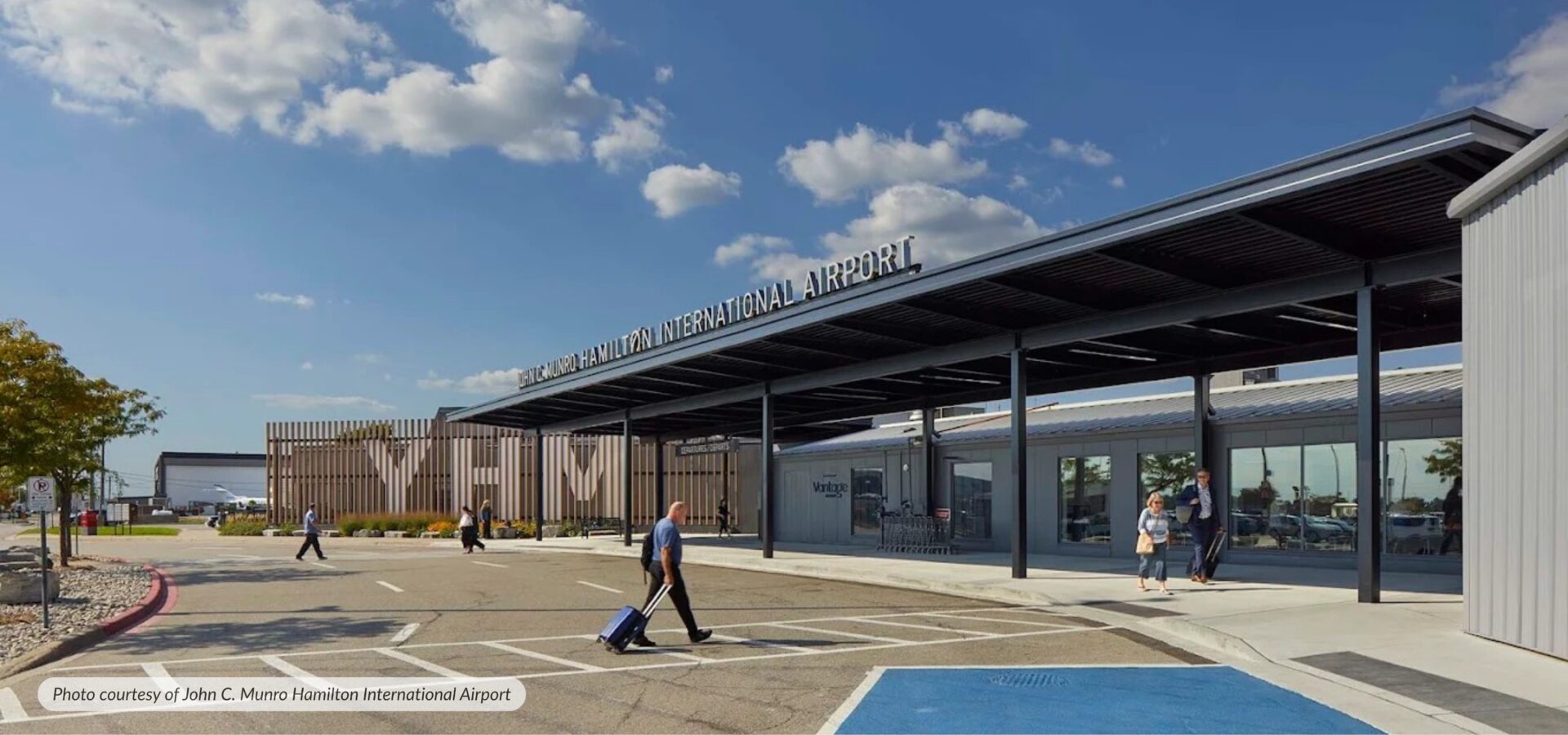
As organizations across Canada navigate the transition toward a low-carbon future, strategic planning has become essential to transforming ambitious sustainability commitments into achievable outcomes. WalterFedy was retained by TradePort International Corporation to undertake a comprehensive Decarbonization and Net-Zero Study for John C. Munro Hamilton International Airport, establishing a practical roadmap to significantly reduce greenhouse gas (GHG) emissions while supporting operational reliability, financial responsibility, and long-term growth.
The study focused on identifying and evaluating opportunities to reduce utility consumption, operational costs, and Scope 1 and Scope 2 greenhouse gas emissions across the Airport’s facilities and fleet operations. Through a detailed review of building documentation, utility data, and on-site asset assessments, WalterFedy developed a comprehensive understanding of the Airport’s existing infrastructure, operational demands, and carbon footprint.
The assessment encompassed five major airport facilities, including the Air Terminal Building, Hangar 5, Common Use Cargo Centre, Glycol Building, and Combined Services Building, along with a diverse fleet of over 50 operational vehicles and equipment assets. Analysis revealed that building operations represented the largest source of emissions, with natural gas used for space heating accounting for more than 75% of the Airport’s total Scope 1 and 2 emissions. Combined with electricity consumption, building-related operations were responsible for over 80% of the Airport’s carbon footprint, highlighting the critical role of facility decarbonization in achieving future emissions targets.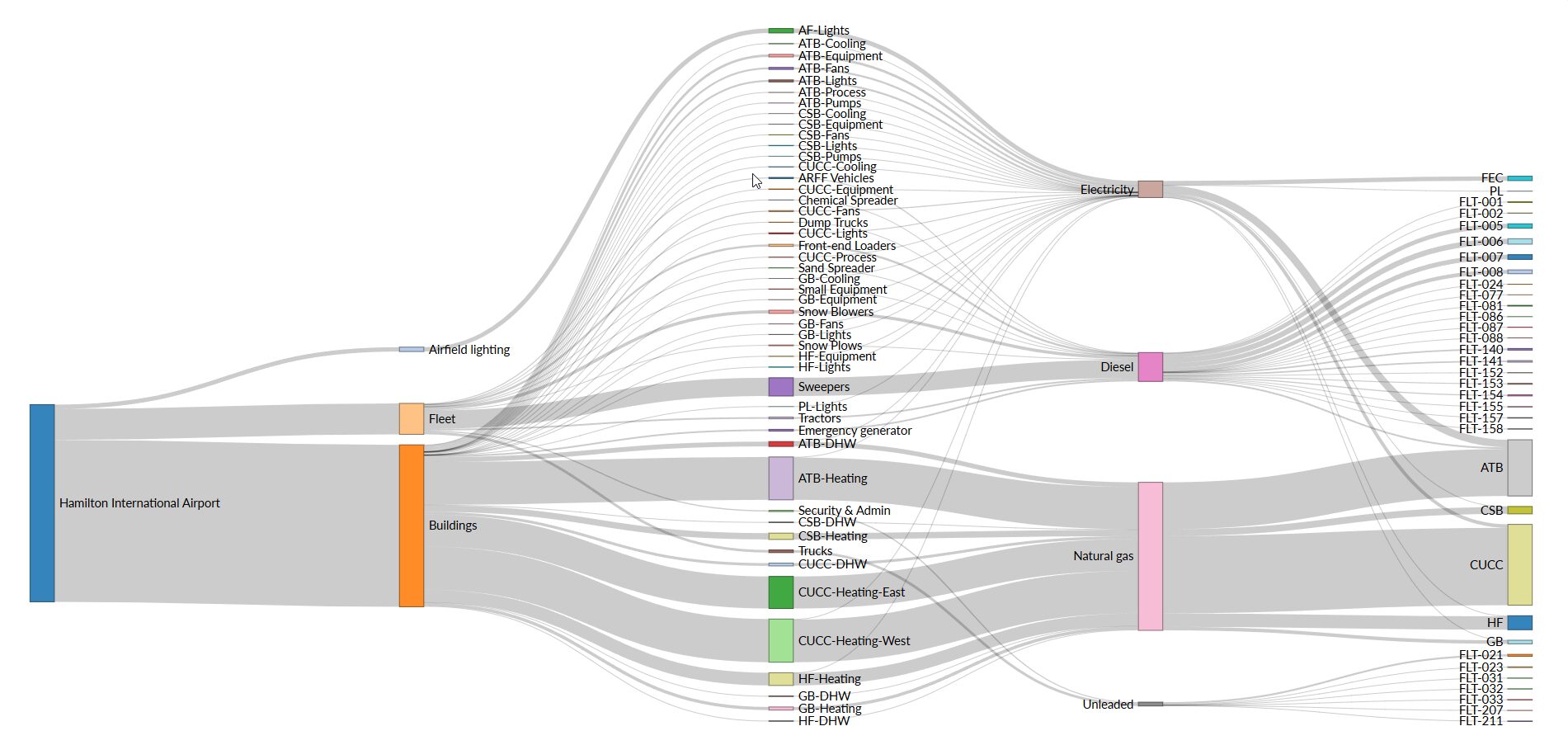
Recognizing that successful sustainability strategies must balance environmental performance with operational realities, WalterFedy evaluated more than 80 potential energy conservation and carbon reduction measures. These ranged from immediate, low-cost improvements that deliver strong returns on investment to transformational long-term initiatives designed to support a net-zero future. Opportunities included building envelope improvements, mechanical system modernization, electrification strategies, renewable energy integration, and fleet transition planning.
To support informed decision-making, four distinct decarbonization pathways were developed and modeled against future utility consumption, greenhouse gas emissions, lifecycle costs, equipment renewal requirements, and maintenance expenditures through 2050.
The Business-as-Usual scenario established a baseline projection assuming standard equipment replacement and maintenance practices without additional sustainability investments.
The Innovative scenario prioritized rapid emissions reductions through aggressive implementation of efficiency measures and centralized energy solutions, creating a pathway toward future district energy compatibility.
The Cost-Efficient scenario focused on achieving the Airport’s 2029 emissions targets through targeted interventions and decentralized heating and cooling solutions while minimizing capital investment.
The Best Value scenario balanced capital expenditures with long-term carbon reduction effectiveness, prioritizing measures that delivered the greatest environmental impact per dollar invested while supporting future flexibility and resilience.
Through comprehensive technical and financial analysis, WalterFedy identified electrified heating solutions—specifically Water Source Heat Pump (WSHP) systems coupled with geothermal infrastructure, or Air Source Heat Pump (ASHP) technologies—as the most effective strategies for addressing the Airport’s largest emissions source: natural gas-based space heating. The study ultimately recommended implementation of the Best Value Scenario, providing a balanced, phased approach that aligns with the Airport’s sustainability vision while maximizing long-term return on investment and greenhouse gas reduction potential.
More than a technical exercise, this project demonstrates the importance of understanding how facilities operate today before defining how they must evolve tomorrow. By combining rigorous data analysis with strategic planning, WalterFedy delivered a clear and actionable roadmap that empowers Hamilton International Airport to move confidently toward a lower-carbon, more resilient future.