
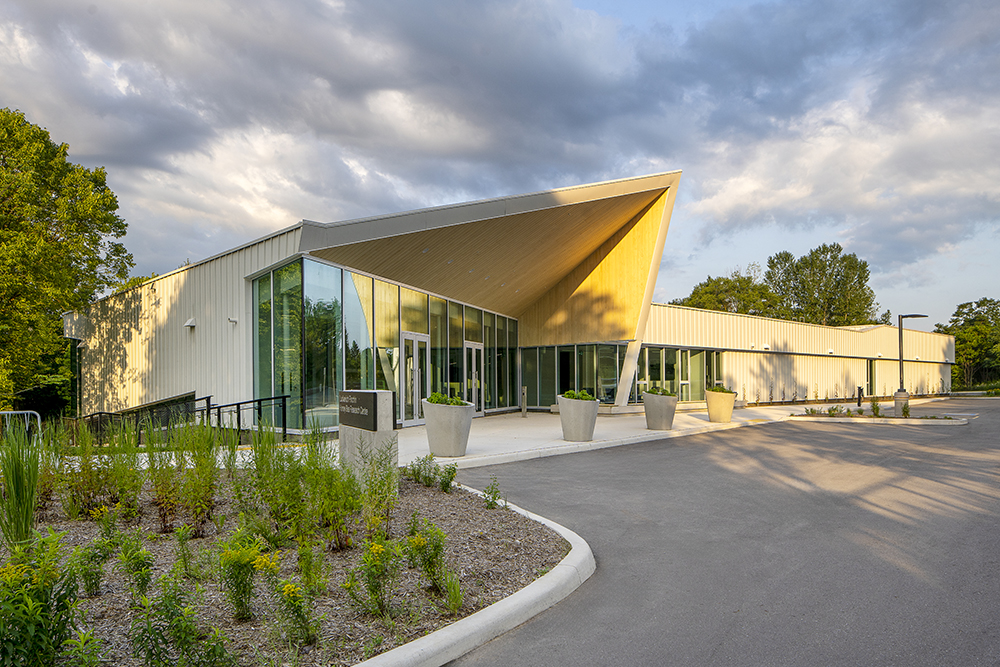
As part of a multidisciplinary team led by Moriyama & Teshima Architects, WalterFedy provided civil engineering services for the development of the Honey Bee Research Centre at the University of Guelph. Situated within the University’s Arboretum lands, the site is currently composed of undeveloped land with a mix of coniferous and deciduous trees. Designed with a strong emphasis on environmental integration, the facility will serve as a living laboratory, fostering education, research, and production activities related to apiculture and environmental sustainability.
WalterFedy’s civil engineering scope encompassed a wide range of essential infrastructure components to support the facility’s functionality and sustainability. This included the design of domestic water and fire flow services sourced from the adjacent Stone Road, as well as the implementation of a private fire hydrant system. A sanitary pumping station and forcemain were designed to efficiently connect to the municipal sewer system on Victoria Road.
In line with best practices for sustainable site development, WalterFedy provided comprehensive grading and stormwater management solutions, incorporating a rain garden and filtration swale to promote natural water filtration and retention. Additional erosion and sediment control measures were integrated to protect the surrounding environment during construction and operation.
The project also included the design of a hardscaped driveway and parking area, as well as hard and soft landscaping elements such as sidewalks, a retaining wall, ground cover, and native plantings. WalterFedy played a key role in coordinating the Site Plan Approval process with the City of Guelph, ensuring compliance with municipal regulations and facilitating a smooth project progression. Furthermore, a Salt Management Plan was developed to mitigate winter maintenance impacts on the surrounding environment.
By incorporating sustainable design principles and enhancing the connection between built and natural environments, the Honey Bee Research Centre will serve as a state-of-the-art facility that supports innovative research and education while promoting ecological stewardship.
